Lemarchand’s Configuration
The Hellbound HeartLemarchand’s Configuration is a musical puzzle box that turns patient manipulation into a passage between worlds. Its intricate, concealed mechanism draws Frank Cotton toward the Cenobites, then gives Kirsty a means to identify Frank and negotiate with them. Across those encounters, the box shifts from coveted instrument to dangerous evidence and, finally, to an object she is left to keep.
Design and Operation
Made by Lemarchand, a craftsman known for making singing birds, the Configuration presents six black lacquered faces without an obvious keyhole, hinge, or indication of where to press. Its difficulty lies in the mismatch between its smooth appearance and its many hidden alignments: only a careful combination of pressure, turns, and pulls releases the separate sections. Frank recognizes it as a puzzle of exceptional complexity, but the box offers no visible guide to its system.
Opening it produces more than a mechanical result. The first movement reveals polished inner surfaces that fragment the solver’s reflection. Each further solution releases another part of the construction and adds a musical element, developing a simple tune into a more elaborate sequence. The music makes progress perceptible, but it does not explain the puzzle; each new section remains a fresh problem for the hands and mind. The box therefore couples sound and touch to its slow disclosure of hidden structure.
Its mechanism also has an effect beyond the room in which it is handled. Frank comes to understand that the box is not merely a map to a destination: solving it is itself a way of travelling, and its final movements open a passage into a world beyond ordinary reality. A Cenobite later explains to Kirsty that it serves as an invocation, notifying the Cenobites across the surface of the real. The object’s operation is thus at once material and metaphysical: its sections move under the solver’s fingers, while the completed sequence summons forces from elsewhere.
Frank Cotton’s Discovery and Opening
Frank’s pursuit begins with rumors of a realm of pleasure for people who have exhausted ordinary human delights. He has heard that several objects might provide access to such a place: a coded theological work said to be in the Vatican, an origami exercise reportedly associated with the Marquis de Sade, and Lemarchand’s elaborate musical box. These stories initially circulate as uncertain possibilities. In Düsseldorf, while smuggling heroin, Frank follows the story of the box to Kircher, who confirms that it exists and arranges to give it to him in exchange for favors.
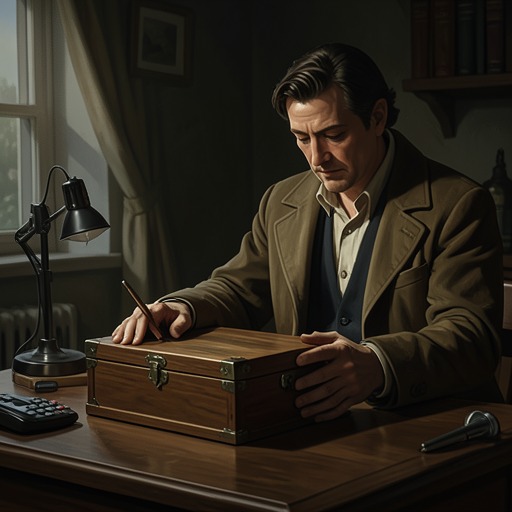
Kircher provides instructions that are both practical and metaphysical, presenting the act of solving the puzzle as a journey. Frank becomes absorbed in this prospect, abandoning drink and drugs as he prepares to open it. In the house where he will later be trapped, he devotes himself to the box and follows the preparations Kircher prescribed. His concentration is so complete that he initially fails to notice a bell ringing; only as the Configuration nears completion does he recognize the sound as a summons from beyond the unseen passage.
Frank has arranged the room for the Cenobites in advance. He scrubs the bare boards, scatters petals, and sets out offerings on an altar, including bones, sweets, needles, and other ritual materials Kircher recommended. He also follows Kircher’s directions for an invocation, treating the preparations with a diligence that contrasts with his earlier drift through dissatisfaction and excess. By the time the box is almost open, however, the approaching summons frightens him. His belief that the passage will bring him new pleasures is already shadowed by the realization that the opening cannot simply be undone.
Kirsty Encounters the Configuration
Later, in the hospital, Kirsty finds the box beside her bed. Its presence is at first a consequence of her condition: after the events at the house, she has been found holding it, and a Cenobite has difficulty removing it from her hand. When it is returned to her, she tells those attending her that she does not know what it means. The box remains with her, however, and the blank hospital room eventually drives her to pick it up and examine it.
Her first attempts yield no obvious entrance. The Configuration is heavier than she remembers, and she turns it repeatedly, tapping, shaking, pulling, and pressing without success. Under the bedside lamp, she notices that traces of blood remain in tiny cracks where one piece meets another. Those marks reveal the general arrangement of the sections and narrow the possible ways to take the box apart. Where Frank approaches the puzzle through sustained, feverish concentration, Kirsty reads its blood-marked surface as a practical guide.
As she works, the same musical mechanism begins to play, and each successful movement adds another detail to the tune. While she is trying to release a further section, the bell sounds. The hospital walls seem subtly displaced, and Kirsty discovers that the toll is not coming from outside. When the light goes out, a Cenobite appears and names the object as the Lemarchand Configuration. The pieces rise above Kirsty’s palm and reassemble themselves, exposing glimpses of their polished interior before the visitor turns her attention back to the box’s purpose.
Evidence, Bargain, and Return
The Configuration’s importance to Kirsty changes when she invokes Frank Cotton’s name. The Cenobites recognize him, and Kirsty offers to deliver him alive in exchange for the chance that they will spare her soul. Their condition makes the box more than a supernatural mechanism: it is the connection through which Kirsty can disclose what she knows and offer the Cenobites a route back to Frank. Her knowledge of the object, first acquired through its physical clues, becomes leverage in a desperate bargain.
After the final confrontation, Kirsty leaves the house and encounters The Engineer at the corner of the street. The figure collides with her and disappears, but the purpose of the contact becomes clear when she finds the Configuration in her hand. It has been returned to her with its surfaces polished and its sections immaculately resealed. Kirsty does not examine it closely; she is certain that no clue to solving it remains. The next person to discover the puzzle will have to explore its faces without the guidance its blood traces once gave her.
The Box as Threshold and Burden
The Configuration repeatedly makes an invisible boundary tangible. Its polished faces conceal a route that cannot be seen until the puzzle is worked; the music marks progress, while the bell signals that the consequences have crossed into the solver’s surroundings. Its apparent status as a self-contained object therefore proves deceptive. Each opening connects a private act of handling to a larger world, and the box’s smooth exterior conceals both the difficulty of entry and the danger of what entry brings.
Its changing role also traces a difference between its two principal human handlers. Frank treats the box as the promised road to a new definition of pleasure, preparing for the arrival he believes he has earned. Kirsty meets it in a hospital, first as an unexplained object and then as a device whose traces can help her survive. At the end, she is left with neither a solved puzzle nor an account of where the box might lead next. She keeps it and waits for another puzzle, while recognizing that the repair of broken hearts may not be a problem that ingenuity or time can solve.